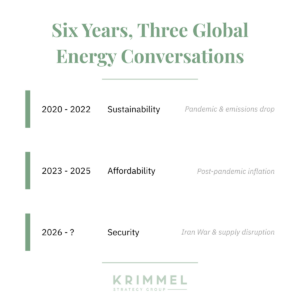
In six years we’ve experienced three profound pivots in the global energy conversation.
➔ From 2020-2022, the focus was on sustainability.
➔ Then from 2023-2025, affordability took over.
➔ And in 2026? It’s all about security.
The World Energy Council popularized the notion of the “energy trilemma”, acknowledging the critical balance between the sustainability, affordability, and security of our energy systems.
The balance is nuanced.
Different energy technologies have different strengths and weaknesses across these dimensions.
And for any given energy technology, these strengths and weaknesses can change from one place to another geographically.
When we zoom out and reflect on the energy conversation over the past half decade or so, we can see distinct phases where different elements of this trilemma captured the most attention.
1️⃣ As the pandemic set in and we navigated through its aftermath, the conversation steered heavily toward sustainability.
Emissions dropped. Skies cleared. The question naturally went to how we could perpetuate these gains as the global economy recovered.
2️⃣ Then as inflation spiraled during the pandemic recovery, the conversation pivoted quickly to affordability.
Protecting the environment is a noble goal.
But when people cannot afford the energy they’ve built their daily lives around, attention goes to controlling costs.
3️⃣ And now in 2026, the Iran War has brought profoundly disruptive shortages in energy supplies.
The conversation has pivoted to energy security, particularly in Asia where aggressive energy rationing is underway.
In just six years, our global energy conversation has leaned in each of the three directions of the energy trilemma.
Over 80% of people live in countries that are net oil consumers. The geography of the Strait of Hormuz isn’t changing.
And in a world where the great powers are increasingly assertive in pursuing their own interests, the risk of disruption to energy flows only grows.
🌏 These are the challenges that political leaders and capital allocators the world over are now confronting.
Our various swings over the past few years have shown the poor calibration that results when indexing too heavily in one direction at the expense of the others.
As we consider what our global energy systems will look like going forward, the indications are building that a balance across the trilemma is what will ultimately win.