China watched oil prices spike over 50% this week. This is exactly what they’ve been preparing for.
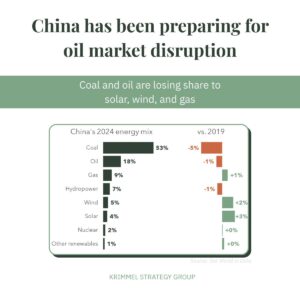
The chart below shows how China’s energy mix has shifted over the past 5 years.
Coal is still responsible for over half of China’s total energy, but its share has dropped 5 points since before the pandemic.
Likewise, the Chinese economy depends less on oil today than it did 5 years ago.
The same is true for hydropower, but that number varies based on changes in annual rainfall.
Notice in which direction China is shifting its energy mix:
➜ Solar is +3 percentage points
➜ Wind is +2
➜ Gas is +1
While nuclear hasn’t moved much, that story is more about how many facilities are actively under construction. Nuclear’s increased contribution will come on the back end of all the construction activity.
China is also building new coal-fired power plants, but these are mostly for back-up purposes. They rarely enter baseload operation.
Energy security sits at the center of China’s strategy.
What happens when your economy relies on oil imports?
A foreign power launches combat operations in the Middle East, and your energy costs spike over 50% in a week.
China has decided that degree of exposure is unacceptable, which is part of the reason solar and wind figure so prominently in their calculus.
There is no Strait of Hormuz that can constrain the amount of sun falling on, or wind blowing across, mainland China.
And then China has increasing amounts of energy storage, and coal, gas, and soon nuclear power plants, to build out its generation footprint.
It’s worth remembering that while oil’s share of China’s energy mix is smaller than it was five years ago, China’s aggregate oil demand is higher now than it was then.
Total energy consumption has simply grown more quickly than oil consumption.
And with the central government aggressively incentivizing the manufacture and domestic sale of electric vehicles, that gap will likely widen.
The next domino: the point at which Chinese oil demand flatlines and eventually starts to fall, like we’ve seen in the US, Europe, and Japan.
For now, China is enjoying taking on a bit less pain than it would have had this Middle East conflict happened even 5 years ago.