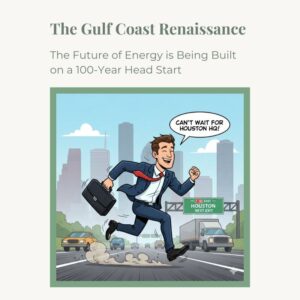
Expand Energy is moving its HQ to Houston. Chevron already did the same thing.
Just last week we got the announcement from Expand Energy, the entity that emerged from the combination of Chesapeake and Southwestern.
Management wrote in its press release that the HQ move “will enable us to capitalize on Houston’s leading role as a gateway to the global natural gas market.”
As CEO Mike Wirth told CNBC at the time of Chevron’s announcement: “Houston is the epicenter of our industry.”
That latter quote says more than it seems.
In the last 5 to 10 years, the world has been having a truly global conversation about our evolving energy systems.
Solar. Wind. Batteries. Nuclear. Geothermal. Hydrogen. Biofuels.
With increasing capital and attention flowing away from fossil fuels…the US Gulf Coast continues its renaissance.
It’s a remarkable feat.
The intuitive expectation was that as the global energy mix shifts away from fossil fuels, legacy centers of hydrocarbon activity would gradually fade.
The exact opposite is happening along the US Gulf Coast.
And this isn’t just an oil & gas story anymore.
Dow and X-energy are pursuing a nuclear-powered manufacturing operation at Dow’s Seadrift facility.
The hydrogen-focused HyVelocity Hub – a collaboration between AES, Air Liquide, Chevron, ExxonMobil, MHI Hydrogen Infrastructure, and Ørsted – is centered here in Houston and extends along the Gulf Coast.
At the end of January, ExxonMobil announced it started its first commercial carbon capture and storage operation in 2025 with CF Industries in Louisiana.
DG Fuels has a multibillion-dollar sustainable aviation fuel production facility, also in Louisiana.
The massive buildout in US LNG export capacity is almost exclusively concentrated along the Gulf Coast.
The list goes on.
Yes, the world’s energy footprint is changing rapidly in a number of directions.
But realization is growing that we’re going to need a full complement of energy sources to meet the world’s future needs.
Against that background, it makes sense to build on the 100-year history of the US Gulf as one of the world’s key energy focal points.