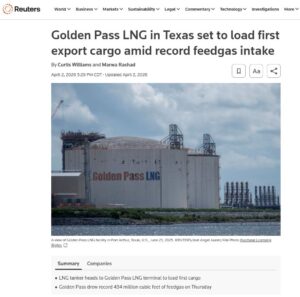
QatarEnergy lost 20% of the world’s largest LNG plant to Iranian missile strikes. This week, it also produced its first LNG in Texas.
In March, Iranian attacks damaged QatarEnergy’s Ras Laffan LNG plant, the largest liquefaction facility in the world.
Nearly 20% of the plant’s capacity went offline and will require yearslong repairs.
But this week, the Golden Pass LNG facility on the Texas/Louisiana border produced its first LNG volumes, which will be loaded on a vessel in late April.
The owners of Golden Pass LNG?
That would be ExxonMobil at 30%, and QatarEnergy at 70%.
Ras Laffan has a capacity of around 80 million metric tons per annum (Mmtpa), or around 10 billion cubic feet per day (Bcfpd).
Losing 20% means 2 Bcfpd goes offline.
The first train of Golden Pass LNG has a little less than 1 Bcfpd of capacity. And the plan is for 3 trains at the facility.
So once Golden Pass LNG is fully built out, QatarEnergy’s share will offset most of what was driven offline at Ras Laffan.
(Train 2 is supposed to become operational in the fall of 2026, and train 3 is set for spring 2027.)
For now, the first train just started producing.
Golden Pass LNG will help QatarEnergy satisfy customer commitments it otherwise wouldn’t be able to if its footprint only existed in the Middle East and was tied to passage through the Strait of Hormuz.
The LNG game requires enormous volumes of capital and commitments lasting a decade or more.
If you’re going to play this game at the highest level, diversification and optionality are key, particularly given that risks can materialize overnight.
It’s one of many reasons the US Gulf Coast should be an attractive location to deploy energy capital for decades to come.