Oil prices are spiking. Do US oil producers have an appetite to step into the existing supply void?
Certainly not Devon Energy.
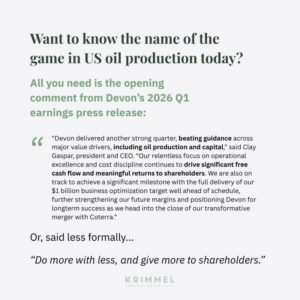
At the very top of the company’s 2026 Q1 earnings release, CEO Clay Gaspar celebrated that the company beat guidance around both oil production and capital.
In other words, the company produced more oil than expected while deploying less capex than expected.
That’s the well construction efficiency story in a nutshell.
There were two other paths through this quarter.
1️⃣ First, they could have spent what they expected to spend, and then beat production guidance even more.
2️⃣ Second, they could have spent even less and tried to avoid a production overshoot entirely.
It’s interesting that the company chose this middle ground, throttling back spend a bit while nudging a bit past production expectations.
You get some incremental revenue from a production overshoot when oil prices are historically high, but you also get credit for being even more disciplined on the capital side than you had planned.
This is the reality of the US oilfield.
The capital discipline approach is sticking firmly.
Even a historically large war-driven supply disruption is not getting a production response from the US oilfield.
And then two days after its earnings release, Devon announced an aggressive share repurchase program.
This is an entirely reasonable position to take.
Much of the market expects a quick resolution to the war and a prompt return to pre-war normalcy in oil markets.
The last thing executive teams want to do is get caught over their skis, betting on an enduring disruption and price spike that never materializes.
They’d rather slow play a production response that may eventually be required. But in the interim they continue to meet shareholder expectations on the discipline front.
❓ It’s an open question what would need to happen geopolitically to convince US producers that the world needs more US oil:
▪️ A sustained price level?
▪️ A duration threshold?
▪️ A specific supply event the market couldn’t shrug off?
Whatever the trigger is, this quarter suggests it hasn’t been pulled yet.