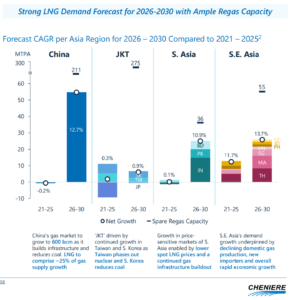
China bought roughly the same amount of LNG in 2025 as it did in 2020. Cheniere hopes that’s about to change in a big way.
Cheniere reported earnings last week. In their presentation, they forecast China’s LNG demand growing at a 12.7% CAGR from now to 2030, after five years of being flat.
The logic behind the reversal is worth understanding.
Cheniere expects LNG prices from 2026 through 2030 to be roughly half of what they were from 2021 through 2025.
That kind of substantial gas price reduction will drive more demand.
The argument is that as more LNG export capacity is built in the US and elsewhere, LNG supply goes up.
If LNG supply goes up more quickly than LNG demand, prices will fall.
And given the large volume of new LNG export capacity approved and mostly under construction, this new LNG supply is coming.
Still, China is the most important unknown variable across a number of critical energy equations.
China’s relatively weak oil demand growth is one reason investors are concerned about stranded oil production assets, which drives a lot of the capital discipline we’re seeing across the upstream sector.
China’s aggressive push to electrify, while diversifying its power generation fleet, is a big part of why potential oil and LNG demand growth are each under pressure.
On the oil side, we have electric vehicles as a headwind.
On the LNG side, we have coal, nuclear, solar, wind, and batteries as headwinds.
And China is ramping up its domestic oil and gas production, displacing imported hydrocarbon volumes across the board.
Knowing energy security is a key consideration of the Chinese central government, it’s easy to see why they prefer to steer toward their own domestic resources.
That posture doesn’t go away because LNG prices fall.
Cheniere’s forecast isn’t unreasonable.
But it’s also a forecast where most of the variables need to break the right way: lower prices, demand response, and limited domestic substitution. And they need to do so simultaneously.
That’s the risk profile underpinning the 12.7% CAGR forecast.