Want to understand how AI changes the economy? Think less about what AI produces and more about what it consumes.
It’s easy, and frankly understandable, to think about all the things AI can do.
It supplies immense cognitive horsepower that in principle makes the humans already in the economy more productive.
More production is more wealth.
That’s how standards of living around the world have grown.
On average, each person can produce much more today than they could 100 years ago
And each person’s added production can be traded for more personal consumption, which generally drives standards of living upward.
That’s one argument for AI’s benefit to the world.
In the past, we’ve added more cognitive horsepower to our economy by adding more people, through above replacement-level birth rates and/or net immigration.
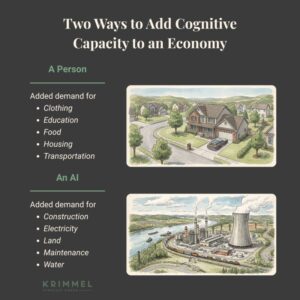
When we added cognition this way, we also added more demand for clothing, education, food, housing, transportation, etc.
Adding AIs doesn’t work the same way.
They don’t need to eat or sleep or wear clothes. They “live” in data centers or other industrial facilities.
Said differently, their consumption pattern is entirely different than that of a human being.
What do they consume?
Electrical power.
And electrical power brings with it the demand for construction, land, maintenance, water, and all the other well-studied ancillaries.
That’s one huge reason the economy is shifting more toward the broader energy space.
Per unit of economic activity, energy’s role is going to increase dramatically in the future relative to the past.
My point is that it’s easy to point to an AI “bubble”, and a short-term race to bring energy online for data centers, and think the push toward energy investments are an isolated wave.
But when you zoom out and look at how the nature of production and consumption patterns will change forever, you realize we’re shifting rapidly into an economy that will be far more leveraged against energy than any economy we’ve had before.
It’s worth thinking through what that means for your own career and finances.
It’s also why I spend so little time litigating the relative merits of different energy technologies.
We’re going to need them all. Badly.