Regardless whether you work in upstream, midstream, or downstream, literacy across all three is key to understanding your own segment.
It’s easy and understandable to put our heads down and get super serious about whatever segment we work in.
They’re all unique. They all have their own operators. Their own service ecosystems. Their own economic drivers.
But as I argue in my cohort programs, to obtain executive-level fluency in any one segment, you need real literacy across all of them.
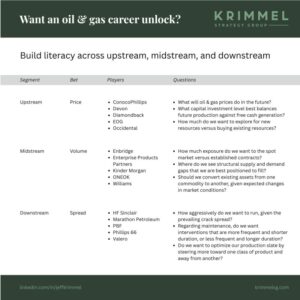
Each of these segments is a bet on a different performance driver:
➜ Upstream is a bet on price
➜ Midstream is a bet on volume
➜ Downstream is a bet on spread
On the upstream side, in the short term, your production is what it is. Your revenue is simply a function of the commodity price: oil, gas, and/or NGLs.
This is the world of ConocoPhillips and its peers.
On the midstream side, your performance is tied to how much volume goes through your pipes. Your fixed costs are enormous. It’s all about filling those pipes at a rate you’ve largely contracted.
This is where we find Enbridge and its peers.
On the downstream side, the story is all about the price of finished products like gasoline, diesel, and jet fuel relative to the price of crude oil. As that spread in prices gets wider, your economics get more attractive.
Here we have Valero and its peers.
👉 Knowing this reality, having a mental model around it, and updating that model as the market evolves is key to better understanding the reality of your own segment.
In upstream, it’s great for pricing to go up, but if you don’t have midstream takeaway access, or if crack spreads are collapsing, then you’re in a pinch.
In midstream, if upstream production volume is outrunning your capacity, you’re leaving money on the table. It’s great to be utilized. But have you properly calibrated against expected future volume inflows (upstream) and outflows (downstream)?
In downstream, it’s awesome if crack spreads widen. But if upstream production or midstream capacity is constrained, you can’t indulge in the wider cracks as much as you’d like.
You don’t need deep-rooted expertise across all segments.
But a substantive awareness gives you a far more complete picture of how your own segment will actually evolve.