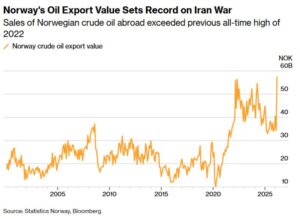
Norway just set a record for crude oil export value. And it came, uncomfortably, during a war.
In March, Norway’s crude exports hit 57.4 billion kroner, up 68% year-over-year.
That’s $6.1 billion, higher than anything the country saw during the 2022 Russia-invasion boom or the post-pandemic recovery.
▶️ This is a win for Norway, first.
The country’s sovereign wealth fund is designed to capture exactly these kinds of windfalls.
Petroleum cash flow transfers to the fund. The fund invests abroad. Only the real return gets spent.
The windfall compounds for decades.
▶️ It’s also a win for Europe.
With Middle East flows disrupted, Europe needs hydrocarbons from somewhere.
US crude travels across an ocean, which adds cost and delay. Norwegian crude comes from Europe’s backyard. Proximity and security matter when the strait is effectively closed.
But here’s the tension.
Norway’s strongest financial moments come from market dislocation.
That’s not something any producer with a long resource runway actually wants. Short-term windfalls erode long-term demand by making buyers more skeptical of hydrocarbons and more receptive to alternatives.
It’s also worth noting what Norway doesn’t do with its own oil.
Domestic consumption of hydrocarbons is vanishingly small.
Passenger transport is largely electrified. Power is renewable.
🌍 Norway effectively produces hydrocarbons for everyone else.
That creates a strange alignment: a country whose citizens barely touch the product it sells, running an institutional machine that converts someone else’s energy crisis into its own multi-generational wealth.
For Europe, Norway’s crude prowess is a win on energy and a loss on narrative.
It’s an admittedly lucrative complication to the story Europe would prefer to tell.