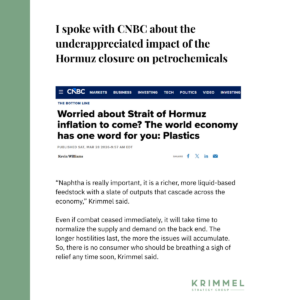
The Strait of Hormuz closure has dramatic implications for oil. But its impact on petrochemicals may be even more consequential.
I spoke with CNBC’s Kevin Williams about this disruption.
Petrochemical facilities here in the US rely heavily on ethane as feedstock, which is produced in abundance across the US oilfield.
In Asia, naphtha instead is the dominant petrochemical feedstock. And the bulk of that naphtha comes from the Middle East.
When we talk about the petrochemicals industry, we’re in a sense talking about two different sectors: one with an ethane gas feedstock, and the other with a naphtha liquid feedstock.
These different feedstocks have important implications for what these plants produce and how broadly those products reach.
Compared to ethane cracking, naphtha cracking produces a wider slate of co-products, which find their way into a huge range of consumer goods.
The point of my conversation with CNBC was that consumer disruption is coming in at least three forms:
➡️ Higher gasoline prices that manifest directly at the pump
➡️ Higher diesel prices that are carried throughout the economy via higher freight and logistics expenses
➡️ Higher naphtha prices that are embedded in much of the world’s daily consumables
The gasoline prices are what get the most attention, given how quickly they manifest and how directly they tie back to oil prices.
But the diesel and naphtha implications are no less real.
They just come with greater delay, and they end up touching an even larger fraction of the global economy.
Check out the CNBC piece for more color on this one.