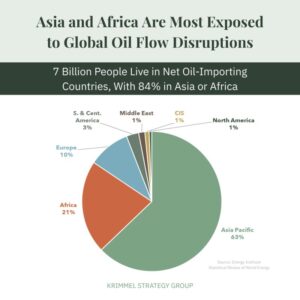
84% of the world’s population lives in net oil-importing countries. And 84% of this group is in Asia and Africa.
Of the world’s 8.3 billion people, 7 billion, or 84%, live in countries that consume more oil than they produce.
That’s 7 billion people whose energy security is most quickly threatened when war breaks out and cuts the world’s access to a key energy source.
5.9 of these 7 billion, or 84%, live in Asia or Africa.
And today’s oil math is working against them.
Oil producers in the US and elsewhere have deeply embraced the notion of capital discipline.
They’re investing as little as possible into their own businesses so that they can instead return huge sums of cash to shareholders.
Investors prefer the cash today because they’re not sure what the future of global oil demand will be.
How much will it grow? For how long? What happens when it rolls over?
That structural underinvestment means there’s less spare capacity to absorb supply shocks when they arrive.
The Iran War is another reason for Asia and Africa to think deeply about the mix of their future energy additions.
It’s not about emissions or warming.
It’s about protecting national security.
It’s about reducing exposure when one of the world’s great powers initiates combat operations and in the process shuts down access to energy.
When we talk about the energy trilemma (the balance of energy sustainability, affordability, and security) no single energy source scores uniformly high or low on all measures.
Hydrocarbons can offer security for some populations while threatening security for others.
Renewables can offer improved affordability in some settings and impose greater costs in others.
It’s a nuanced walk that each nation takes to create the best outcomes for its own people.
And for 5.9 billion people in Asia and Africa, the Iran War is a stark reminder of the total cost of their oil exposure.