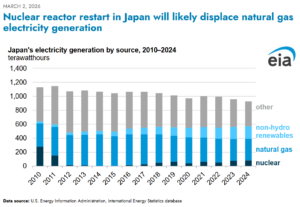
Japan restarted a unit at its largest nuclear power plant. And LNG developers globally are paying attention.
The US EIA estimates the restart of Unit 6 at Kashiwazaki-Kariwa Nuclear Power Station could displace 1.3 million tons of LNG, or 62 billion cubic feet of natural gas imports annually.
62 Bcf per year equals 0.2 Bcf per day.
For context, the US exports 15 Bcf per day of LNG in aggregate, of which around 0.6 Bcf per day goes to Japan.
If that displacement came entirely from imports of US LNG, it would cut US exports to Japan by roughly one-third.
The restart of this one nuclear power unit is not going to distort global LNG flows.
It’s more about what happens when other nuclear power units come online. Or when existing facilities expand capacity.
For countries without domestic gas reserves, nuclear power can offer an energy security advantage over imported LNG.
📍 This is where the Two Timelines matter.
In the near term, we still need gas as a dispatchable resource, to meet rapidly growing demand and balance the variable output of renewables.
That story is well established.
The longer-term question is whether nuclear emerges as a baseload competitor that displaces a meaningful share of natural gas’s role in power generation.
A global nuclear renaissance, if it materializes, is still at least a decade away given permitting constraints and construction timelines.
But US LNG export projects are being built on multi-decade return horizons.
And as those two timelines converge, the risk/return calculus around LNG investment becomes harder to navigate.
I’ve heard these concerns raised from the stage at more than one industry event over the past year.
The restart of Unit 6 at Kashiwazaki-Kariwa is a small, tangible data point.
👉 The question worth considering: at what scale of nuclear restarts does this go from a manageable headwind to a structural challenge for LNG demand?